Introduction
Disputes are an inevitable part of life. They arise in families, workplaces, businesses, communities, religious institutions, and even between governments. While conflict itself is natural, the way it is managed often determines whether relationships are strengthened or broken, opportunities are created or lost, and justice is achieved or delayed.
For generations, litigation has been the traditional avenue for resolving disputes. Although courts play an essential role in administering justice and interpreting the law, litigation is not always the most suitable solution. Court proceedings can be costly, time-consuming, emotionally exhausting, and adversarial, often leaving parties with damaged relationships and limited control over the outcome.
This is where Alternative Dispute Resolution (ADR) comes in.
Across the world, ADR has become an indispensable component of modern justice systems, providing individuals, businesses, organisations, and communities with flexible, efficient, and collaborative methods of resolving disputes outside the courtroom. In Kenya, ADR has gained significant recognition as part of the justice system and is increasingly encouraged by courts and institutions because of its ability to promote access to justice, reduce case backlogs, and encourage peaceful coexistence.
Whether you are involved in a family disagreement, commercial dispute, workplace conflict, land matter, or community disagreement, understanding ADR can help you choose the most appropriate path toward a practical and lasting resolution.
What Is Alternative Dispute Resolution (ADR)?
Alternative Dispute Resolution (ADR) refers to a range of structured processes used to resolve disputes without relying solely on traditional court litigation.
Rather than allowing a judge to determine the outcome, ADR processes encourage parties to communicate, negotiate, collaborate, or submit their dispute to an independent neutral who assists in reaching a resolution.
ADR is not a single process. Instead, it encompasses several dispute resolution mechanisms, each designed to meet different needs and circumstances.
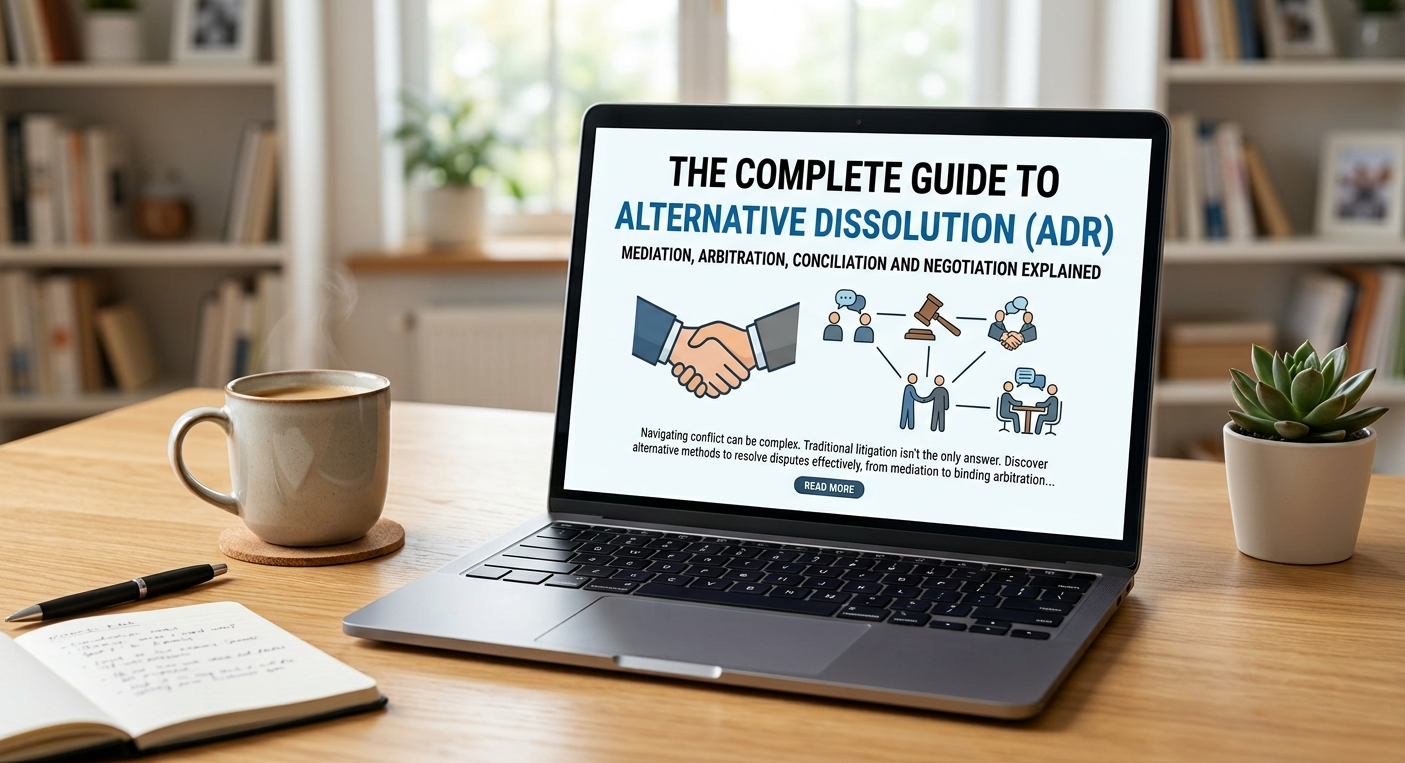
The most widely recognised ADR methods include:
• Mediation
• Arbitration
• Conciliation
• Negotiation
Other ADR processes include expert determination, restorative justice, mini-trials, early neutral evaluation, and collaborative dispute resolution.
Why Is ADR Becoming Increasingly Popular?
The growing popularity of ADR reflects changing attitudes toward conflict resolution. Increasingly, individuals and organizations recognize that disputes do not always require lengthy court battles.
Some of the key reasons people choose ADR include:
• Faster resolution of disputes.
• Lower costs compared to litigation.
• Greater privacy and confidentiality.
• Flexibility in scheduling and procedures.
• Preservation of personal and business relationships.
• Increased party participation and control.
• Reduced emotional stress.
• Creative and practical solutions.
• Improved compliance with agreements.
For many disputes, ADR offers an opportunity to resolve conflict in a manner that is both effective and respectful.
The Main Forms of ADR
1. Mediation
Mediation is one of the most widely used ADR processes worldwide.
It is a voluntary, confidential, and structured process in which an independent and impartial mediator assists parties in communicating effectively, exploring their interests, and negotiating mutually acceptable solutions.
Importantly, the mediator does not decide the outcome.
Instead, the parties remain in control of both the process and the final agreement.
Best suited for:
• Family disputes
• Divorce and separation
• Child custody
• Workplace conflicts
• Commercial disputes
• Land disputes
• Community conflicts
• Partnership disagreements
• Neighbour disputes
• Faith-based disputes
Advantages
• Confidential
• Cost-effective
• Relationship-focused
• Flexible
• Faster than litigation
• Encourages voluntary compliance
• Preserves dignity and respect
2. Arbitration
Arbitration is a more formal ADR process.
Instead of going to court, parties present their dispute before an independent arbitrator or panel of arbitrators.
Unlike mediation, the arbitrator hears evidence, considers legal arguments, and makes a decision known as an arbitral award.
Depending on the agreement between the parties and the applicable law, the award may be legally binding and enforceable.
Best suited for:
• Commercial disputes
• Construction disputes
• International business transactions
• Contractual disputes
• Technical disputes
Advantages
• Faster than court proceedings.
• Greater privacy.
• Parties may choose an arbitrator with relevant expertise.
• Flexible procedures.
• Enforceable decisions.
3. Conciliation
Conciliation is closely related to mediation but differs in one important respect.
While a conciliator facilitates communication between the parties, they may also take a more active role by proposing possible settlement options.
The conciliator helps bridge differences and encourages agreement while maintaining impartiality.
Conciliation is particularly useful where communication has completely broken down or where parties require greater guidance during negotiations.
4. Negotiation
Negotiation is perhaps the oldest and most common form of dispute resolution.
It involves direct discussions between the parties with the aim of reaching an agreement without involving a third-party decision-maker.
Negotiation may occur:
• Informally.
• Through legal representatives.
• With professional advisers.
• As part of another ADR process.
Successful negotiation depends upon effective communication, preparation, active listening, creativity, and a willingness to understand each party's underlying interests.
Other ADR Processes
Modern ADR has expanded beyond the four traditional methods.
Additional mechanisms include:
Expert Determination
An independent expert decides technical issues requiring specialized knowledge, such as engineering, accounting, or valuation disputes.
Early Neutral Evaluation
A neutral expert provides an independent assessment of the strengths and weaknesses of each party's case before litigation progresses.
Mini-Trials
Senior representatives from each party present abbreviated versions of their cases before an independent facilitator to encourage settlement discussions.
Restorative Justice
Commonly used in community and youth matters, restorative justice focuses on repairing harm, restoring relationships, and promoting accountability.
ADR vs Litigation
Although both ADR and litigation seek to resolve disputes, they differ significantly.
ADR Litigation
Collaborative - Adversarial
Usually confidential - Generally public
Flexible procedures - Formal court procedures
Faster resolution - Often lengthy
Lower costs - Higher costs
Parties retain greater control - Judge controls outcome
Preserves relationships - May damage relationships
This comparison explains why many disputes today are resolved through ADR before reaching trial.
Choosing the Right ADR Process
No single ADR method is suitable for every dispute.
The appropriate process depends on factors such as:
• Nature of the dispute.
• Relationship between the parties.
• Complexity of legal issues.
• Desired outcome.
• Need for confidentiality.
• Time considerations.
• Cost.
• Whether a binding decision is required.
Consulting an experienced ADR practitioner can help parties determine the most appropriate approach.
The Future of ADR
As societies become more interconnected and disputes grow increasingly complex, ADR will continue to play a central role in promoting peaceful dispute resolution.
Technological advances have also transformed ADR through online mediation and virtual arbitration, making professional dispute resolution more accessible than ever before.
Businesses, governments, educational institutions, faith-based organisations, and communities increasingly recognise that collaborative dispute resolution often produces more durable outcomes than adversarial proceedings.
ADR is no longer simply an alternative; it is becoming an essential pillar of modern justice systems.
Conclusion
Alternative Dispute Resolution represents a shift from confrontation toward collaboration, from rigid procedures toward flexibility, and from imposed decisions toward mutually acceptable solutions.
Whether through mediation, arbitration, conciliation, or negotiation, ADR empowers parties to resolve disputes more efficiently while preserving relationships, reducing costs, and promoting constructive dialogue.
By understanding the different ADR mechanisms available, individuals and organisations can make informed decisions about how best to address conflict and move forward with confidence.
Conflict may be inevitable, but lengthy and destructive disputes do not have to be.
Ready to Explore Alternative Dispute Resolution?
If you are facing a dispute and would like guidance on the most appropriate ADR process, Geoffrey Musera, CPM – Certified Professional Mediator | Conflict Resolution Practitioner, is committed to helping individuals, families, businesses, organisations, and communities resolve disputes through ethical, confidential, and professional dispute resolution services.
Contact today to schedule a confidential consultation and discover how ADR can help you find practical, sustainable, and mutually acceptable solutions.
About the Author
Geoffrey Musera, CPM, is a Certified Professional Mediator and Conflict Resolution Practitioner with over five years of experience in conflict resolution and Alternative Dispute Resolution (ADR). He provides professional mediation and conflict resolution services to individuals, families, businesses, organisations, and communities across Kenya and through secure online mediation for clients worldwide.